
Forged Wheel Fitment Verification Checklist
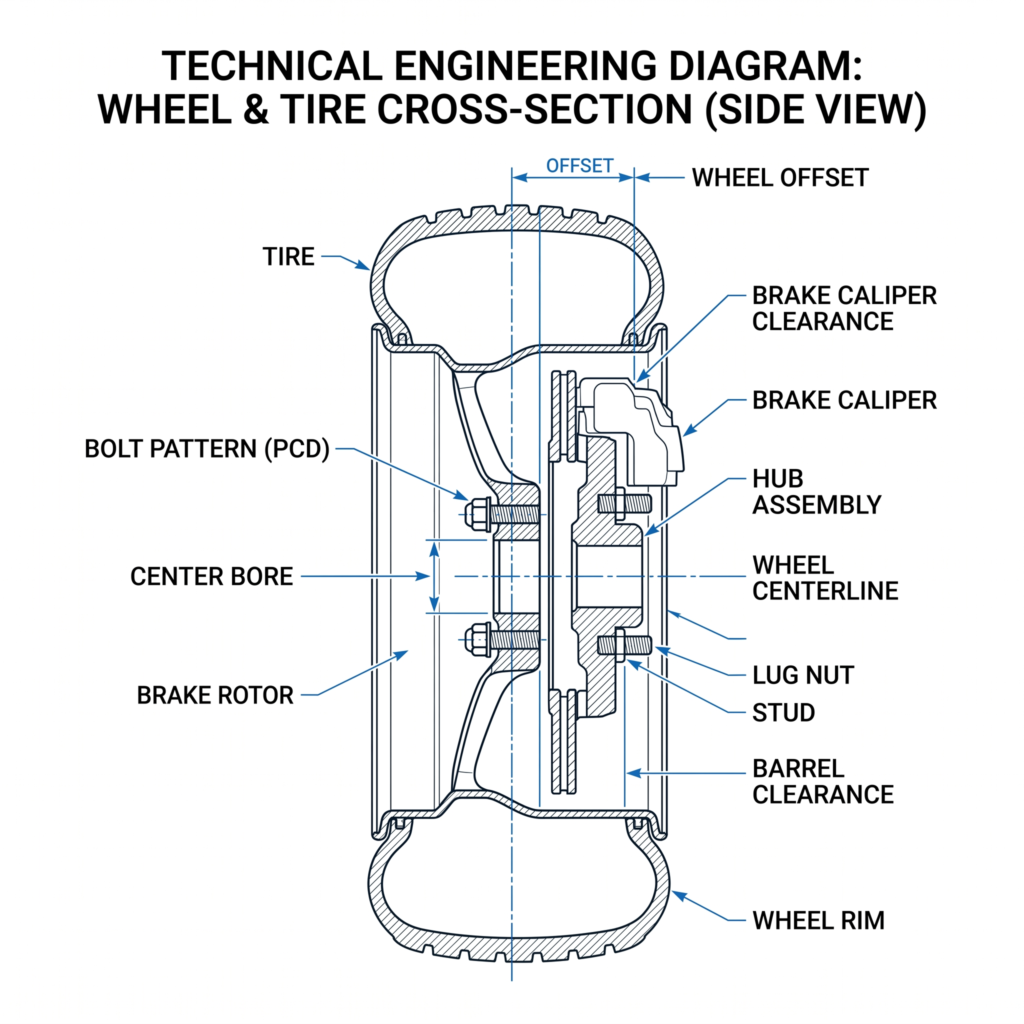
Quick answer: Before ordering a forged wheel, verify the chassis code and market, the axle load and wheel load rating, the bolt pattern and fastener seat, the center bore, offset and backspacing, caliper and barrel clearance, and tire and fender clearance; then torque to spec and re-check after the first drive.
Ordering the wrong wheel is expensive twice — once to buy it, once to ship it back — and some fitment mistakes are not just expensive, they are dangerous. A wheel that centers on its lug bolts instead of its hub, or that is loaded past its rated capacity, can fail in ways a tire never will. This checklist walks through the ten checkpoints ANKUSI's engineering team verifies before any forged wheel is cut, in the order they actually matter: vehicle identification first, physical clearances last. Use it before you order a set for your own car, or hand it to a shop that is installing wheels you already bought.
This is a reference guide, not a substitute for a qualified technician. Always confirm final numbers against your vehicle's owner's manual or a shop's direct measurement before installation.
1. Vehicle, Year & Chassis Verification
Start with the exact chassis code, not just the model name. The same nameplate can span two or three completely different platforms with different bolt patterns and center bores — we document real examples of this across our own fitment guide library, where, for instance, older BMW models on the 5x120 bolt pattern share a badge with newer models that switched to 5x112. A model year alone can be ambiguous around a generation changeover, so confirm the build date or chassis code (stamped on the VIN plate or in the vehicle's registration documents) rather than assuming from the calendar year. Regional market versions (US, EU, UK, ZA, CN) of the same model can also run different factory wheel specs, so match the fitment data to your actual market, not just your model name.
The Honda Civic Type R shows how much a chassis code matters: the FD2 and FN2 run 5x114.3 with M12x1.5 studs, while the FK2 that followed switched to 5x120 with M14x1.5 studs. Our Civic Type R wheel specs by generation table lists all seven chassis codes side by side.
2. Axle Load & Wheel Load Rating
Every wheel has a maximum load rating, usually stamped on the back of the spokes or barrel. That rating has to meet or exceed your vehicle's per-wheel share of its GAWR (Gross Axle Weight Rating) — found on the door-jamb placard — with margin for cargo, passengers, and dynamic loads like cornering and potholes. This matters most on trucks, SUVs, and anything towing: a wheel that is rated fine for a compact sedan can be dangerously undersized on a heavy pickup, even if the bolt pattern happens to match. When you switch to a larger wheel diameter, re-check the load rating on the new size specifically — load capacity is not guaranteed to carry over between sizes from the same wheel family.
3. Bolt Pattern (PCD) & Fastener Seat
Bolt pattern (PCD, or pitch circle diameter) has two numbers: lug count and circle diameter in millimeters, like 5x114.3. Both must match exactly — there is no "close enough" on a bolt circle. Just as important, and often overlooked, is the fastener seat type. Lug nuts and bolts come in conical (60°) seats, ball/radius seats, and flat seats that need a separate washer; the seat on your lug hardware has to match the seat machined into the wheel's lug holes. Mixing seat types looks like it tightens fine but leaves the wheel clamped off-center, which shows up as vibration or, in the worst case, a lug that backs off over time. If you are changing wheel brands, plan on new lug hardware matched to the new wheel's seat design rather than reusing your factory lugs.
4. Center Bore & Hub-Centric Fit
The center bore is the hole in the middle of the wheel that rides on the vehicle's hub. A hub-centric wheel — bore machined to match the hub diameter almost exactly — lets the hub itself center the wheel, with the lug bolts only clamping it in place. A wheel with a bore larger than the hub is lug-centric: it relies on the lug bolts alone to center the wheel every time it is installed, which is more prone to vibration and, over years of use, to the lug holes wearing slightly oval. If a wheel's bore is larger than your hub, use hub-centric rings sized to close that gap — do not run it bare. A bore smaller than the hub will not fit at all and should never be forced. Because ANKUSI forges every wheel to order, we cut the bore to your hub diameter directly, which is why our fitment pages list center bore as a primary spec alongside bolt pattern.
5. Offset & Backspacing Conversion
Offset is the distance, in millimeters, from the wheel's true centerline to its mounting face. Positive offset pulls the wheel in toward the chassis; negative offset pushes it out. Backspacing measures the same relationship from the opposite reference point — the distance in inches from the mounting face to the back edge of the wheel barrel — which is why some shops and forums quote one and some quote the other. The conversion is straightforward:
Backspacing (in) ≈ Wheel Width (in) ÷ 2 + Offset (mm) ÷ 25.4 + 0.5
The +0.5 accounts for the flange allowance built into most rim profiles. Every one of our vehicle fitment pages lists this calculation worked out for the OE, flush, and maximum-aggressive spec on that specific car, so you do not have to run the math by hand. Getting offset wrong in either direction causes real problems: too much positive offset (wheel tucked in) can rub the suspension or brake components; too much negative offset (wheel pushed out) can rub the fender lip or overload the wheel bearing with leverage it was not designed for.
6. Caliper Envelope & Spoke Clearance
The inside barrel of the wheel has to clear the brake caliper through its full range of motion, not just when the wheel is bolted on stationary. This is the single most common fitment failure on lower-offset or narrower-spoke wheel designs, especially when paired with an aftermarket big brake kit that was not part of the vehicle's original spec. Our fitment pages document the flush and max specs against the factory brake package; if your car runs a big brake upgrade, that clearance has to be re-verified against the actual caliper dimensions of the upgraded kit, not the factory one, before ordering a wheel with an aggressive offset.
7. Barrel Clearance on Concave & Reverse-Lip Wheels
Deep concave and reverse-lip wheel designs push more of the wheel's mass and barrel depth toward the inside of the car, which raises the risk of the barrel itself contacting the strut body, sway bar end link, or tie rod — not just the brake caliper. This risk is highest on MacPherson strut front suspensions, where the strut body sits close to the wheel's inner barrel, and it gets worse as backspacing decreases (more negative offset). If you are speccing a deep concave design, confirm barrel clearance against your specific suspension type at full steering lock and full compression, not just at ride height with the wheels pointed straight.
8. Tire Width, Diameter & Suspension/Fender Clearance
A wheel's width has a recommended tire section-width range — going too narrow or too wide outside that range distorts the tire's contact patch and sidewall profile. Separately, changing overall tire diameter (a taller or shorter tire than stock) changes your vehicle's effective gearing, which shifts speedometer accuracy and, on newer vehicles, can affect ABS and traction-control calibration if the change is large enough. Keep overall diameter within about 3% of factory unless you are deliberately building for a different use case (like taller all-terrain tires on a truck) and are prepared to address the calibration shift. Beyond the numbers, always do a physical clearance check — full steering lock in both directions, full suspension compression — before finalizing a tire and wheel combination.
9. Torque Specs & Post-Installation Inspection
Torque your own vehicle's specified value — typically somewhere in the 80–140 Nm (roughly 60–103 ft-lb) range depending on the vehicle and fastener size, but always confirm the exact figure in your owner's manual or service data, since running too loose risks the wheel working free and running too tight can warp the brake rotor or strip the stud. Tighten in a star (crisscross) pattern, not sequentially around the circle, so the wheel seats evenly against the hub. After the first 50–100 miles (80–160 km) of driving on a newly installed wheel, re-check torque, since a wheel can settle slightly as everything seats fully. From there, check torque periodically as part of normal maintenance, the same way you would check tire pressure.
The 10-Point Checklist
Print this section, or download the PDF below, and check each item off before you place an order or hand a wheel to your installer.
- Confirmed exact chassis code / generation and market variant, not just model year.
- Checked wheel load rating against per-axle GAWR from the door-jamb placard.
- Verified bolt pattern (lug count + PCD) and matched fastener seat type.
- Matched center bore to hub diameter, or sized hub-centric rings correctly.
- Calculated offset/backspacing and confirmed it against the vehicle's flush and max specs.
- Checked caliper clearance against the actual brake package installed (OE or upgraded).
- Checked barrel clearance against strut, sway bar, and tie rod at full lock and compression.
- Confirmed tire section width is within the wheel's rated range.
- Kept overall tire diameter within roughly 3% of factory, or accounted for the calibration shift.
- Torqued in a star pattern to spec, and scheduled a re-torque after 50–100 miles.
Want a printable copy for the shop floor?
Download the free PDF version of this checklist — the same ten checkpoints, formatted for printing and checking off by hand.
About This Checklist
Written by: Emma, Engineer at ANKUSI WHEELS
Published: August 21, 2026 • Last updated: August 22, 2026
This checklist reflects general wheel and tire fitment engineering principles used industry-wide, cross-referenced against ANKUSI's own forged wheel production and fitment-verification process. General reference sources for the terminology and conventions used above include SAE International's wheel and rim standards (the SAE J328 series covering passenger car, light truck, and utility vehicle wheels) and the Tire and Rim Association (TRA) Year Book, alongside individual vehicle manufacturers' published service specifications. Always defer to your specific vehicle manufacturer's documentation for exact torque values, load ratings, and OE specs — this guide explains the concepts and shows you what to check, not a replacement for those numbers.
Checking a Jeep? Our Jeep bolt pattern by model guide lists the bolt pattern and center bore for the Wrangler, Grand Cherokee, Gladiator and other Jeep models by generation.
Frequently Asked Questions
Do I need to check all 10 points for every wheel purchase?
Yes, especially points 1–5 (chassis, load rating, bolt pattern, center bore, offset), which determine whether a wheel physically fits and mounts safely at all. Points 6–9 (clearances, torque) matter most when you are pushing toward an aggressive fitment, running a deep concave design, or have modified brakes or suspension — but they are worth a quick check on any installation.
What happens if I use a wheel with the wrong center bore?
If the bore is larger than your hub and you skip hub-centric rings, the wheel relies entirely on the lug bolts to stay centered, which increases vibration and long-term wear on the lug holes. If the bore is smaller than your hub, the wheel will not seat flush against the hub face at all and should not be force-installed.
Can I use my factory lug nuts on aftermarket wheels?
Only if the fastener seat type matches. Many aftermarket and forged wheels use a different seat design than the factory wheel, so check the seat type before assuming your factory lugs will work — using the wrong seat can leave the wheel improperly clamped even though it feels tight.
How do I know my wheel load rating is high enough?
Check the load rating stamped on the wheel (usually near the valve stem or on the back of a spoke) against your vehicle's GAWR divided by the number of wheels on that axle, found on the door-jamb placard. When in doubt on a heavy vehicle or one that tows, size up rather than down.
Is this checklist specific to forged wheels?
The engineering principles apply to any wheel, forged or cast. We wrote it from our own forged wheel fitment-verification process because that is what we build, but the same ten checkpoints apply whether you are ordering custom forged wheels or shopping for factory replacements.
Want us to double-check your numbers against your exact vehicle?
Worked example for a 5x112 hot hatch: our Golf GTI wheel offset and specs by generation (Mk1 to Mk8) shows how an 8J ET45 or 8.5J ET45 wheel moves the tire compared with the factory 7.5J ET51 wheel.
Driving an Audi? See the Audi RS3 bolt pattern and A3/S3 specs by generation for a worked fitment example.
Driving an M car? Our BMW M bolt pattern guide for the M2, M3, M4, M5, M6 and M8 shows why one badge can mean 5x120, 5x112 or 5x132.
Driving a Porsche? Our Porsche 911 bolt pattern guide for the 930 to the 992 shows why every lug-bolt 911 is 5x130 and where center-lock wheels break the rule.
Checking a Chinese car? See our guide to Chinese car bolt patterns and center bores at the 2026 Paris Motor Show, covering BYD, Omoda, Jaecoo, Geely and Zeekr.
Fitting wheels to a BMW 128i or 135i? Our BMW 135i wheel offset guide for the E82 and E88 shows how far each popular setup moves the wheel in and out compared with the factory 18-inch wheels.
Driving a 5 Series? Our BMW 5 Series wheel specs by generation guide lists the bolt pattern, center bore and factory offset for every chassis from the E28 to the G60.
Working on a Subaru? Our Subaru WRX wheel specs by generation guide shows where the bolt pattern changes from 5x100 to 5x114.3 and which STI wheels will swap.
For a BMW 2 Series, the BMW 2 Series wheel specs by generation guide shows how the bolt pattern changes from 5x120 on the F22 to 5x112 on the F44 and G42, with factory offsets checked against two sources.
Driving a Mazda? The Mazda wheel interchange guide shows which CX-5, CX-50, Mazda3, CX-30 and MX-5 wheels share 5x114.3 and a 67.1 mm center bore, and where the MX-5 switches between 4x100 and 5x114.3.
Need answers from the manufacturing side instead of just sales copy?
Contact ANKUSI through WhatsApp or WeChat for discussions on forged wheel customization, fitment, finishes, and project feasibility.