
Drag Wheel Backspacing: How to Measure It, Convert to Offset & Size 15x10 Rears and 15x3.5 Fronts
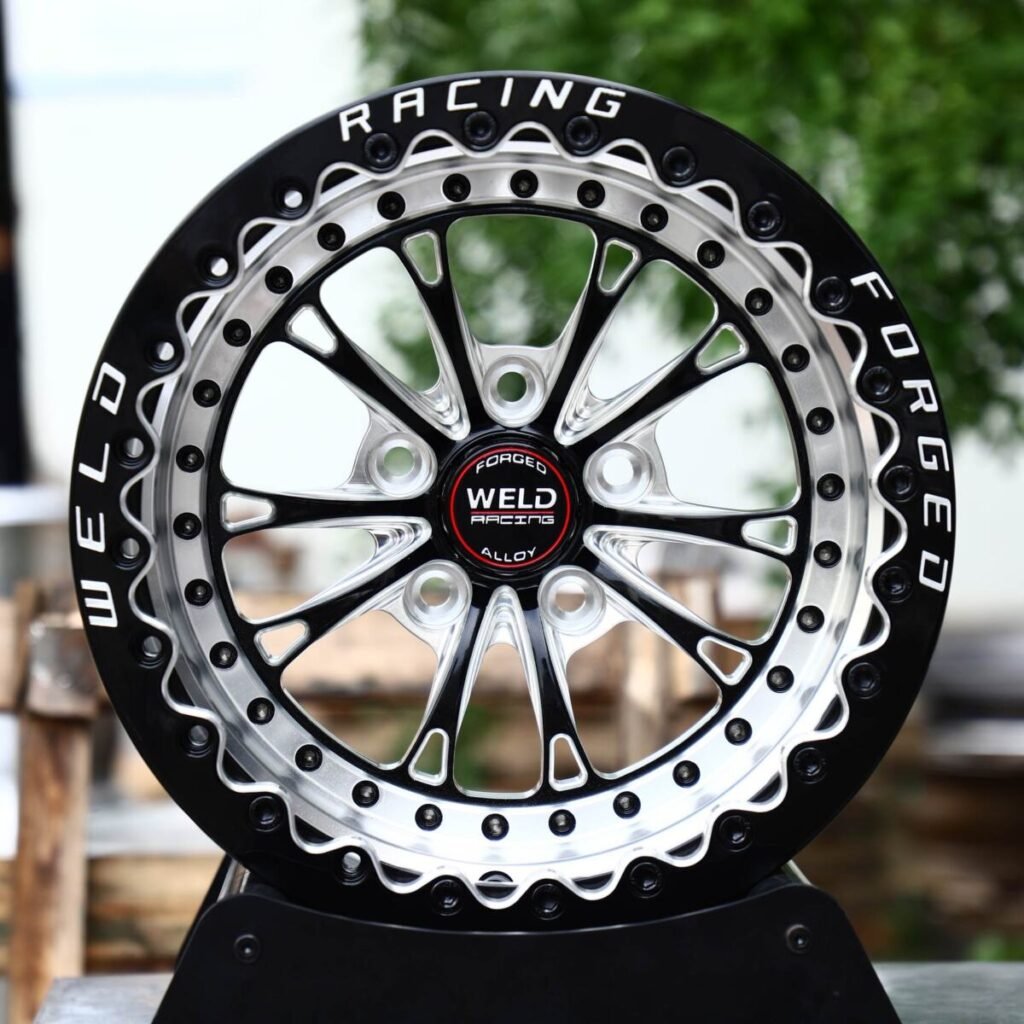
Drag wheel backspacing is the distance from the wheel's mounting pad to the inner (brake-side) edge of the rim, measured in inches. Drag racers quote it instead of offset because it answers the only question that matters at the track: how far does the wheel reach toward the frame rail, the leaf spring or the shock? To measure it, lay the wheel face-down, rest a straightedge across the inner lip, and measure down to the hub pad. To convert it to offset, subtract half of the wheel's overall width (nominal width plus one inch) and multiply by 25.4. A 15x10 with 7.5" of backspacing is therefore a +51 mm wheel; a 15x3.5 front runner with 1.75" is -12.7 mm.
This guide gives you the measuring method, the conversion formula with a worked chart for the sizes drag racers actually order, and the three places where a backspacing number goes wrong on a real car. It sits inside our track and drag wheel setup pillar; for a platform-specific worked example see the S550/S650 Mustang drag wheel sizes guide.
What backspacing is, and why drag racing uses it instead of offset
Backspacing is a direct, physical measurement: pad to inner lip, in inches. Offset is a derived number: the distance from the pad to the wheel's centerline, in millimetres, positive when the pad sits toward the street side. Both describe the same geometry, but backspacing is the one you can check with a ruler in the pits and the one that maps straight onto the clearance you have between the tire and the chassis.
That is why drag wheel catalogues list a 15x10 as "4.5", 5.5", 6.5" or 7.5" backspace" rather than "-25, 0, +25, +51 mm". The racer knows how much room there is inside the tub; the backspacing figure tells them how much of the wheel's width goes inboard. The rest of the width goes outboard, toward the quarter panel, which is the second clearance you check.
How to measure wheel backspacing in four steps
You need the wheel off the car, a straightedge longer than the wheel is wide, and a tape or steel rule. The method below is the one Weld Racing's fitment video and independent tire guides describe, and it works on a bare wheel or one with a tire mounted.
- Lay the wheel face-down on a soft, level surface so the mounting pad faces up. Clean the pad so dirt does not add to the reading.
- Rest a straightedge across the inner lip, on the rim edge itself, not on a beadlock ring or a tire sidewall. Keep it parallel to the pad.
- Measure from the straightedge down to the mounting pad, at 90 degrees to the straightedge. Do not measure to the hub bore or to a raised lug seat; the pad is the flat surface that touches the brake hat or axle flange.
- Measure twice at two points across the pad and take the average. On a welded two- or three-piece drag wheel the difference should be under 1/16"; if it is larger, the wheel is bent or the straightedge is not sitting on the lip.
Write the figure down in inches to the nearest 1/8", which is how drag wheels are catalogued. If you also want offset, the next section converts it.
Backspacing to offset: the formula and a drag-size chart
The conversion needs one piece of information that catalogues rarely print: a wheel's overall width is about one inch more than its nominal width, because the bead flanges add roughly half an inch per side. A "10 inch" wheel measures close to 11 inches lip to lip. Half of that overall width is the backspacing that gives zero offset.
Offset (mm) = [ backspacing (in) − (nominal width + 1) ÷ 2 ] × 25.4
Check it against a real catalogue listing: a Weld Racing-style RT-S 15x10 with 7.5" backspace is sold as a +51 mm wheel, and the formula returns (7.5 − 5.5) × 25.4 = +50.8 mm. The chart below runs the same formula across the sizes that cover most 5-lug drag builds. Values are calculated; the catalogue rounding on a specific part may differ by a millimetre.
| Wheel size | Overall width ÷ 2 | Backspacing | Offset | Typical use |
|---|---|---|---|---|
| 15x3.5 | 2.25" | 1.75" | -12.7 mm | Front runner, narrow strut or spindle car |
| 15x3.5 | 2.25" | 2.25" | 0 mm | Front runner, more inboard room |
| 17x4.5 | 2.75" | 2.25" | -12.7 mm | Front runner for late-model brakes |
| 15x8 | 4.5" | 5.5" | +25.4 mm | Rear, drag radial 255–275 |
| 15x10 | 5.5" | 4.5" | -25.4 mm | Rear, narrowed housing or tubbed car |
| 15x10 | 5.5" | 5.5" | 0 mm | Rear, stock-width housing with room |
| 15x10 | 5.5" | 6.5" | +25.4 mm | Rear, slick inboard of the quarter |
| 15x10 | 5.5" | 7.5" | +50.8 mm | Rear, late-model unibody (Mustang, Camaro) |
| 15x12 | 6.5" | 5.5" | -25.4 mm | Rear, 29–31" slick on a tubbed car |
| 17x10 | 5.5" | 6.5" | +25.4 mm | Rear, 17" drag radial, big brakes |
| 17x10 | 5.5" | 7.5" | +50.8 mm | Rear, late-model IRS cars |
| 17x11 | 6.0" | 7.5" | +38.1 mm | Rear, 315–335 drag radial |
Two things fall out of the chart. First, every extra inch of backspacing on the same width is exactly +25.4 mm of offset, so you can interpolate in 1/4" steps (6.35 mm) without the formula. Second, the late-model unibody cars live at the high-backspacing end of the table: a 7.5" backspace on a 15x10 pushes the wheel 2" inboard of centre, which is why those wheels clear a stock quarter panel with a 275 or 295 drag radial. Our offset, backspacing and tire diameter calculator does the same arithmetic both ways and adds tire section width to it.
Choosing rear backspacing for 15x10 and 17x10 drag wheels
The right rear backspacing is the one that centres the tire in the available space, with the larger of the two gaps on the inboard side. Measure the car, not the old wheel: with the car at ride height and the axle centred, measure from the axle flange face to the nearest inboard obstruction (frame rail, spring, shock body, inner wheel well) and from the flange face to the inner edge of the quarter panel lip. Subtract the tire's inflated section width from the total, split what is left, and the inboard half plus the half-width of the tire is your maximum backspacing.
On a stock-width housing in a late-model Mustang or Camaro that calculation usually lands at 7" to 7.5" on a 15x10 or 17x10, which is why most of the 5-lug drag racing wheels we build for those cars are quoted that way. A tubbed car with a narrowed housing goes the other direction, down to 4.5" or 5.5", because the housing was shortened to put the tire where the frame rail used to be. If you are ordering a beadlock 10-spoke forged drag wheel for a slick, remember that the beadlock ring sits outboard of the bead and does not change the backspacing figure, but it does add to overall width on the street side.
For a street-driven drag radial car that keeps the stock brakes, a split 5-spoke forged drag wheel with a polished lip in 17x10 at 7.5" backspace is the usual starting point on the 5x115 Mopars; check brake caliper clearance separately, because backspacing says nothing about spoke-to-caliper distance.
Need a backspacing that is not in the catalogue? Every ANKUSI drag wheel is machined to order, so a 6.75" or 7.25" backspace costs the same as a standard figure. Send us your flange-to-rail and flange-to-quarter measurements and we will confirm the size before machining.
Front runner backspacing: 15x3.5 and 17x4.5
Front runners are chosen for weight and rolling resistance, so the width is fixed by the tire (front tires in the 4.5" section range run on 3.5" to 4.5" rims) and backspacing is the only variable left. Because the wheel is so narrow, half of its overall width is only 2.25" on a 15x3.5, and the usual 1.75" backspace puts the pad half an inch outboard of centre: -12.7 mm of offset.
That small negative offset does two useful things. It moves the narrow tire away from the strut body or the inner fender, and it widens the front track slightly, which helps a car that walks at the top end. The cost is scrub radius: with -12.7 mm the steering axis no longer meets the tire's centreline, so a front runner car tugs more over seams and under braking than the same car on street wheels. If the car has late-model brakes that will not clear a 15" wheel, a 17x4.5 at 2.25" backspace gives the same -12.7 mm with room for the caliper.
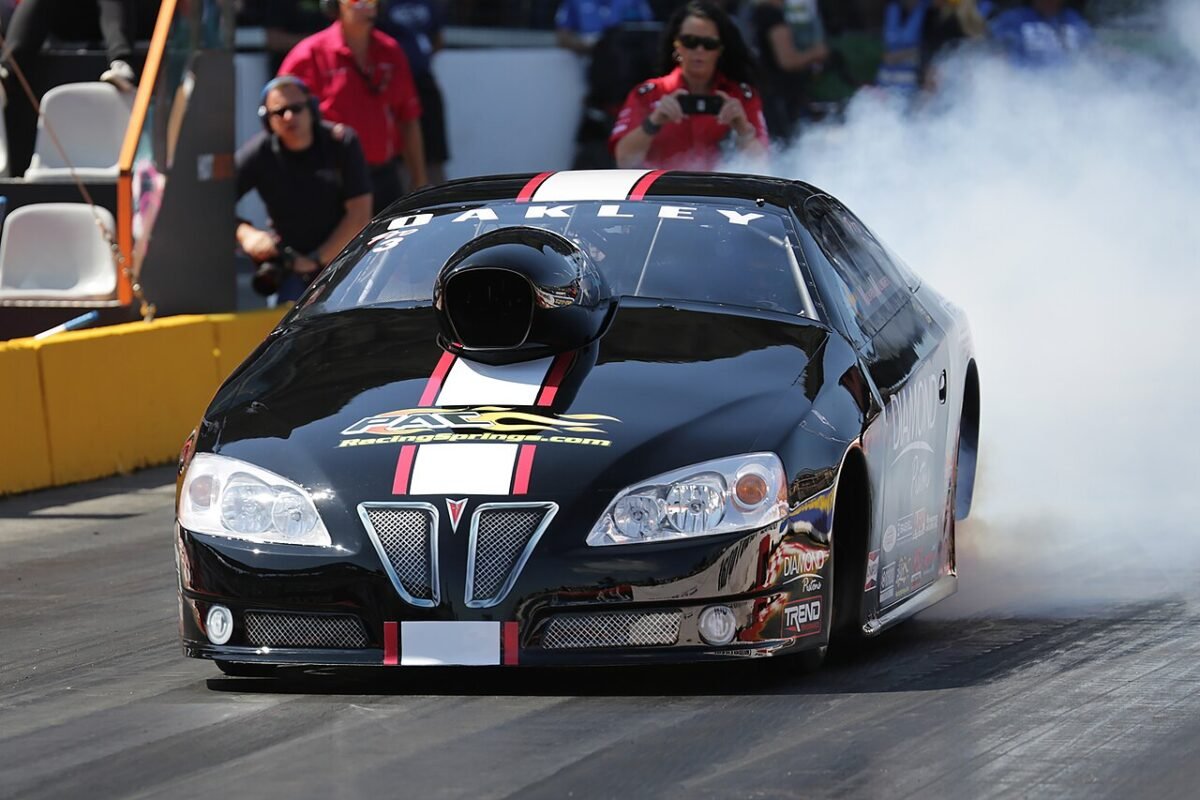
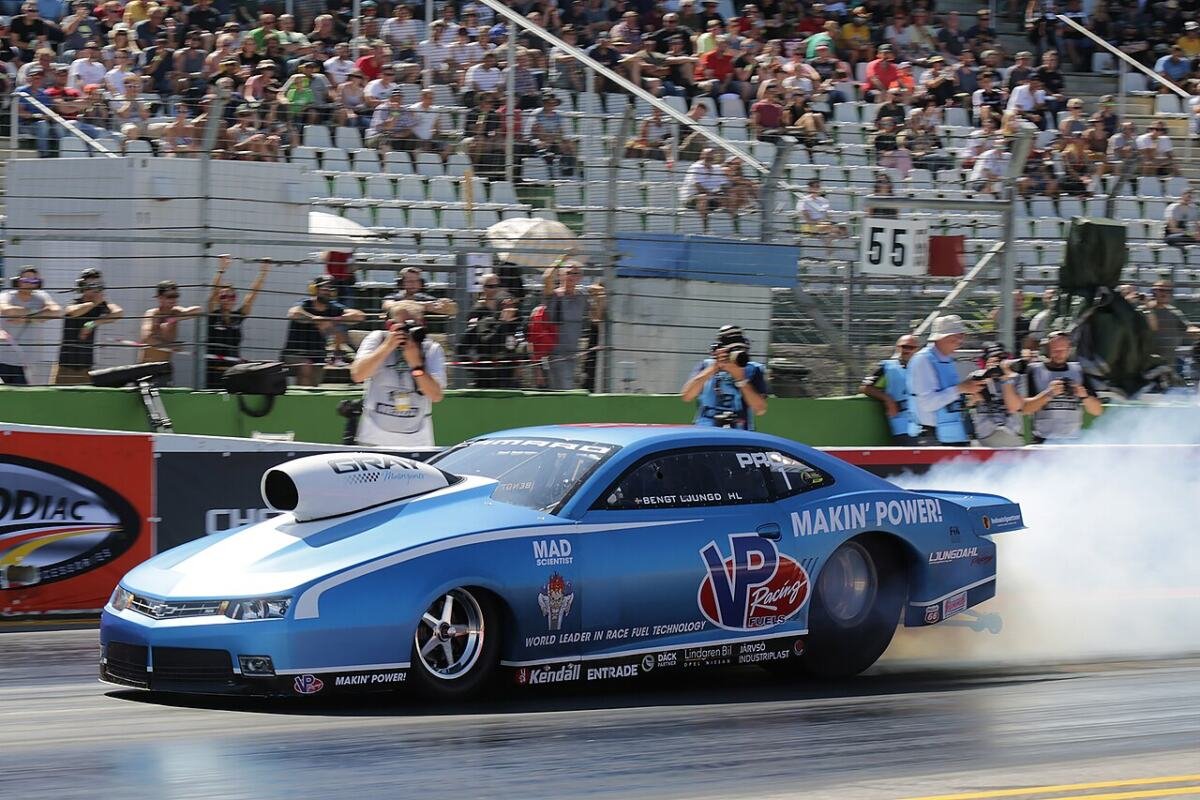
Front wheels carry their own SFI specification (15.2) separate from rear drive wheels (15.1), and the Pro Stock car in the photo above is running exactly this layout: a narrow front runner on a short backspace and a wide, high-backspace slick wheel tucked under the quarter. The beadlock drag wheels guide covers when the rear needs a ring; front runners do not.
Three backspacing mistakes that show up on race day
Measuring to the beadlock ring. A straightedge laid across a beadlock ring instead of the inner lip reads the ring's thickness as extra width and puts the pad in the wrong place by up to half an inch. Always rest the straightedge on the rim edge.
Treating 10" as 10". Converting with the nominal width instead of the overall width makes every offset 12.7 mm too positive. A "zero offset" 15x10 is a 5.5" backspace wheel, not a 5" one.
Copying a backspacing between chassis. A 7.5" backspace that is perfect on a 5x114.3 Mustang can hit the frame rail on a 5x120 Camaro with a different housing width. Measure flange-to-rail on the car you are building; our bolt-pattern pages for 5x114.3, 5x120 and 5x115 list the centre bores to match, but the backspacing is always car-specific.
SFI wheel specifications in one paragraph
SFI 15.1 covers drag race rear drive wheels and 15.2 covers front wheels; 15.3 is the higher-load rear spec used in Pro Modified and similar classes, and 15.4 is reserved for Top Fuel and Funny Car beadlock drive wheels. Certified wheel models are re-tested every 24 months, and NHRA requires a conformance label on certified rear wheels. Which classes must run which spec is set by the sanctioning body's rulebook, not by the wheel maker, so check the current SFI Foundation listing and your series rules before you order. Backspacing does not affect certification, but a wheel built to a non-catalogue backspace is a different part number and needs its own label.
For narrow front wheels, see the front runner drag wheels guide, which explains how front tire rim range and backspacing work together.
Frequently asked questions
How do I convert backspacing to offset?
Subtract half of the wheel's overall width (nominal width plus 1 inch, divided by 2) from the backspacing, then multiply by 25.4. A 15x10 with 6.5" backspace is (6.5 − 5.5) × 25.4 = +25.4 mm.
What backspacing is zero offset on a 15x10 wheel?
5.5 inches. The overall width of a 15x10 is about 11 inches, and half of that is the backspacing that puts the mounting pad on the centreline.
Does a beadlock ring change backspacing?
No. Backspacing is measured from the mounting pad to the inner rim lip on the brake side; the beadlock ring is on the outboard bead. It does add to the wheel's overall width on the street side.
What backspacing do 15x3.5 front runners use?
Most are catalogued at 1.75" (about -12.7 mm offset) or 2.25" (zero offset). The shorter figure moves the tire away from the strut and widens the track; the longer one tucks it in for cars with inner-fender room.
Is more backspacing always safer for clearance?
No. More backspacing moves the wheel inboard, away from the quarter panel but toward the frame rail, spring and shock. The correct figure centres the tire between the two obstructions, with the larger gap inboard.
Rim width comes before backspacing. Our drag radial vs slick wheel width guide shows which widths each common drag tire is approved for.
Related forged drag wheels
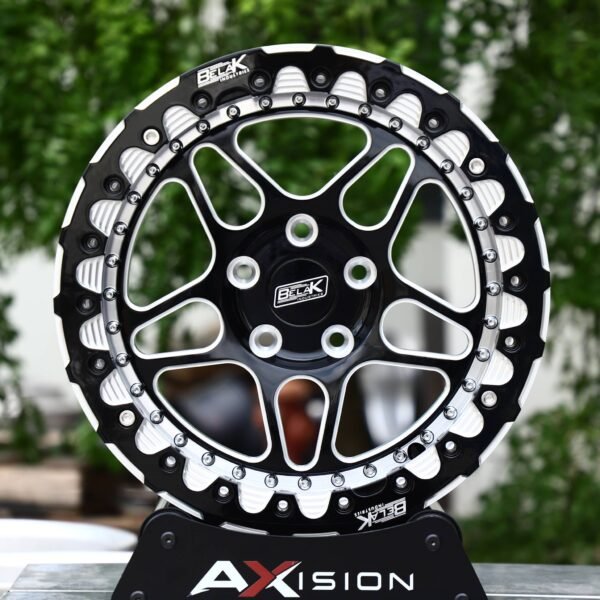
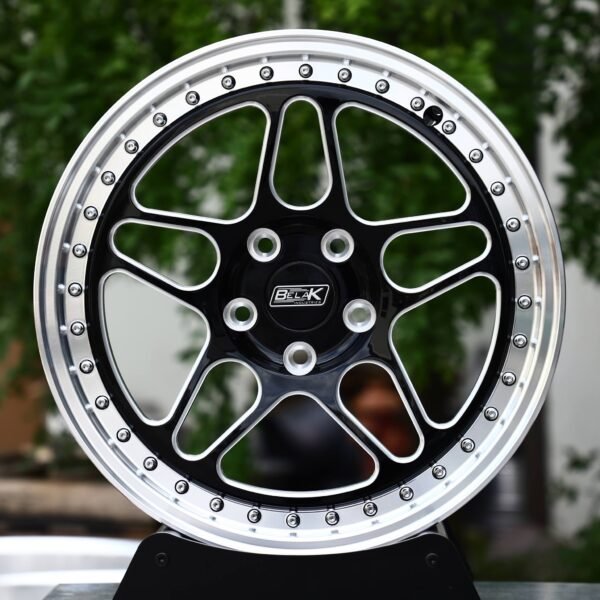
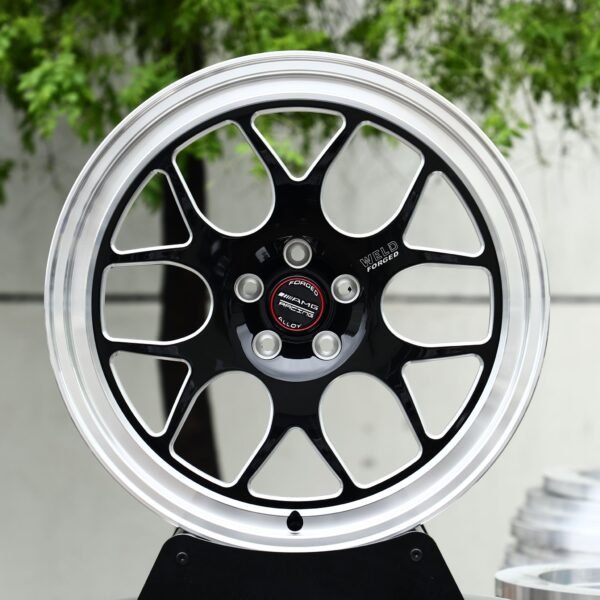
Browse the full 5-lug drag racing wheel range, every size machined to the backspacing you measure.
Need answers from the manufacturing side instead of just sales copy?
Contact ANKUSI through WhatsApp or WeChat for discussions on forged wheel customization, fitment, finishes, and project feasibility.