
20 Inch Forged Wheels: Fitment, Width & Offset Guide
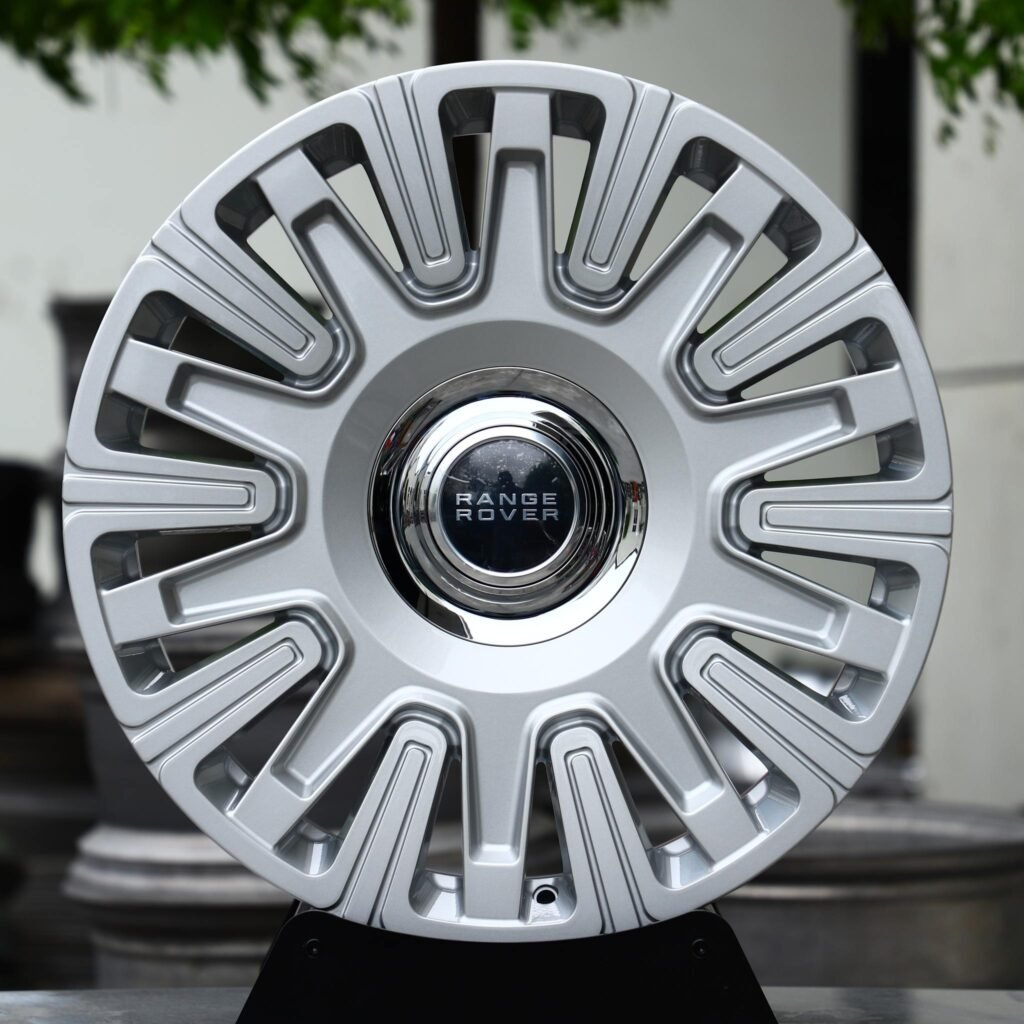
Quick answer: Diameter does not decide fitment. A 20-inch forged wheel has to match the car's bolt pattern (5x112 on most recent BMW, Audi and Mercedes models, 6x135 on the Ford F-150), its center bore, and an offset that for many 20-inch fitments falls between ET+20 and ET+45.
If you are shopping 20 inch forged wheels, the diameter is the least important number on the spec sheet. What actually decides whether the wheel survives your car and your roads is how the barrel is built and whether the fitment is right for your hub. A 20-inch wheel is a big lever arm — every pothole, curb strike and hard corner feeds more load into the spokes and the mounting face than a 17 or 18 does. That is exactly why we forge them from solid 6061-T6 billet instead of pouring molten aluminum into a mold: the grain flow follows the shape of the wheel, so the metal is densest right where the stress concentrates. Below is how we think about a 20 on the shop floor — construction, fitment, width and offset — so you can spec one that fits and lasts.
Why forging matters more at 20 inches than at 17
A cast wheel has a random internal grain and tiny gas porosity left over from the casting process. At 17 inches those weaknesses are usually buried under enough material that you never notice. Push the diameter to 20 and two things happen at once: the unsprung mass climbs, and the bending moment on every spoke gets longer. That combination is where cast wheels start cracking at the spoke root after a hard hit.
Forging kills both problems. We start with an aircraft-grade 6061-T6 aluminum billet and press it under a 10,000-ton forging press so the aluminum grain is compressed and continuous through the spoke and into the mounting pad. The result is a denser, tougher structure with no internal voids, which is why a properly forged 20 can be run thinner — and lighter — than a cast wheel of the same size while carrying a higher load rating. On a heavy SUV or an EV, that weight saving is not cosmetic: less rotating unsprung mass means the dampers control the tire better, and the drivetrain has less inertia to spin up. Because we machine every wheel from billet in-house on CNC lathes and multi-axis mills, we can also cut the back of the spokes down to remove metal exactly where it is not doing structural work — something you cannot do with a fixed casting mold.
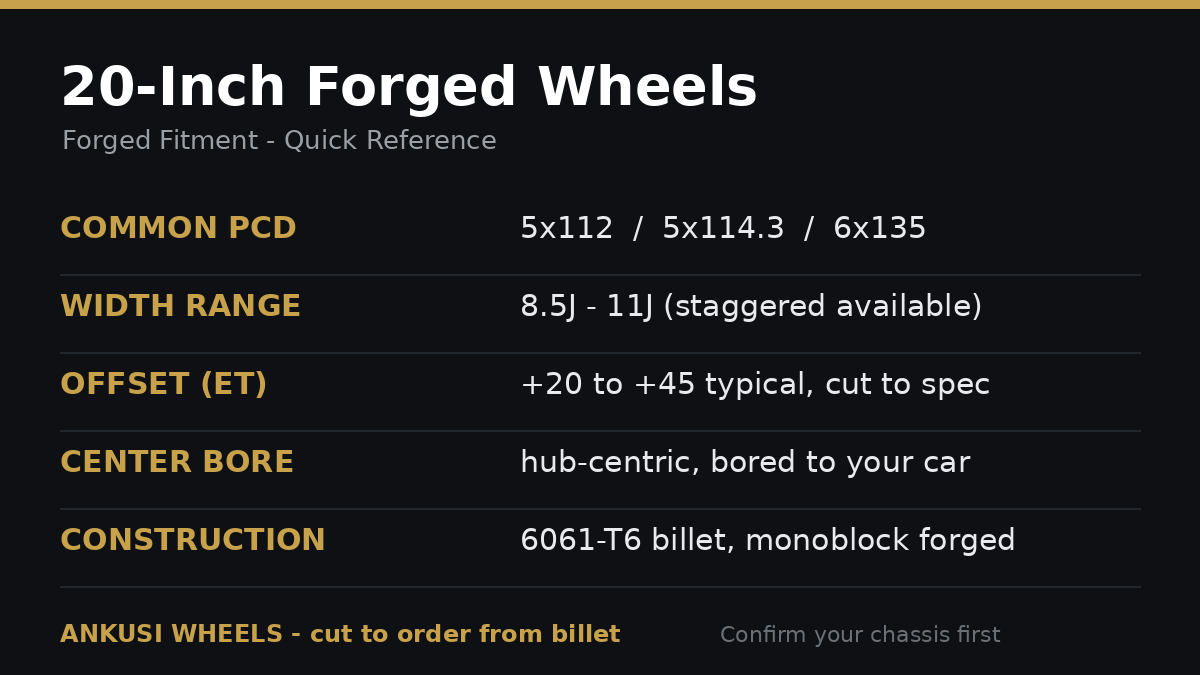
Fitment: the three numbers that decide if your 20 inch forged wheels bolt up
Diameter tells you nothing about fit. Three numbers do: bolt pattern (PCD), center bore (CB) and offset (ET). Most modern German platforms — recent BMW, Audi and Mercedes chassis — run a 5x112 bolt pattern, which is why so many 20-inch upgrades on those cars share hardware. Full-size American trucks like the Ford F-150 are commonly 6x135, and 4x4 SUVs scatter across 5x114.3, 6x139.7 and others depending on the platform. Those are common examples, not a guarantee for your specific car — bolt patterns and especially center bores changed across model years, so we always ask you to confirm your exact chassis before cutting. If you are not certain what your car uses, contact us to verify your specific vehicle's specs rather than guessing from a forum post.
Center bore is the one people skip and regret. If the wheel's bore is larger than your hub, the wheel is riding on the lug seats instead of the hub, and on a 20 that shows up as vibration you cannot balance out. Because we cut to order from billet, we bore each wheel hub-centric to your car instead of shipping a big generic bore with plastic rings. That is a real advantage of ordering direct from the factory rather than buying a one-size-fits-many wheel off a shelf.
Width, offset and how much concave a 20 can actually take
On a 20, width and offset are where the look is won or lost, and also where clearance problems hide. A staggered setup — say a 20x9J up front and a 20x10.5J or 20x11J rear — is common on rear-drive performance cars, and the wider the barrel, the more room you have to run an aggressive concave spoke face. But concave is not free: the deeper the spoke sits, the more you have to watch brake caliper clearance on the inside and fender clearance on the outside. We spec the offset (ET) to pull the face out toward flush without letting the tire rub the arch. For a lot of 20-inch fitments the usable window lands somewhere around ET +20 to ET +45, but that depends entirely on your width, tire and suspension, so we model it against your car rather than handing you a fixed number. If you want a genuinely deep, motorsport-style concave face, that is a case where the barrel geometry has to be designed for it from the start — see our racing wheel line for how far the spoke can be dished when the wheel is built for it.
SUV, 4x4 and EV: where load rating stops being optional
A 20-inch wheel on a 4,000-lb sports sedan and a 20-inch wheel on a 6,000-lb SUV or EV are two completely different engineering problems even at the same size. The heavy vehicle needs a higher load rating, and a taller sidewall budget for off-pavement work. Every wheel we build is engineered to meet JWL/VIA and DOT load and impact standards, and we test to those before a design leaves the shop — that matters far more on a loaded 4x4 or a two-ton EV than on a light coupe. If your 20s are going on a truck or an all-terrain build, the barrel and spoke section have to be sized for that weight, which is why we treat off-road and truck fitments as their own design bracket rather than just widening a car wheel. For lighter street cars, a one-piece monoblock is usually the lightest, stiffest way to get to 20 inches.
Finish, center caps and going custom
Because everything is done under one roof — forging, machining, our fully automated dust-free paint line, QC and packaging, with nothing outsourced — the finish is part of the build, not a separate vendor's problem. Brushed, gloss or satin paint, two-tone, polished lip: we apply and inspect it in-house, and the center cap carries a proper logo rather than shipping blank. If you have a size, offset or bolt pattern that no catalog wheel matches, that is the normal case for us, not a special request — we cut bespoke diameters, widths, offsets and drillings to order, and we do it for Wholesale, OEM, ODM and private-label runs as well as one-off sets.
For Jeep owners moving up to 20-inch wheels, the Jeep bolt pattern by model guide shows which models share the same bolt pattern and center bore.
Getting the right 20 inch forged wheels for your car
The short version: pick the construction for the weight of your car, confirm your PCD, center bore and offset against your actual chassis, and size the width to the look you want without ignoring brake and fender clearance. If you tell us your exact vehicle, ride height and tire plan, we will spec a set to fit it and cut it from billet — no middleman, straight from the factory. Contact us for a factory-direct quote or to confirm the fitment data for your specific car before you commit to a size.
Frequently Asked Questions
What bolt pattern do 20 inch forged wheels use?
It depends entirely on your car, not the diameter. Many modern BMW, Audi and Mercedes chassis use 5x112, full-size trucks like the Ford F-150 are commonly 6x135, and 4x4 SUVs range across 5x114.3, 6x139.7 and others. Confirm your exact chassis before ordering, or contact us to verify your vehicle's spec.
Are forged 20 inch wheels lighter than cast?
Yes, when they are designed properly. Because forging gives a dense, continuous grain with no internal porosity, a forged 20 can be run thinner and lighter than a cast wheel of the same size while carrying a higher load rating. On heavy SUVs and EVs that unsprung-weight saving is the whole point.
How much offset do I need for a 20 inch wheel?
For many 20-inch fitments the usable window lands roughly around ET +20 to ET +45, but it changes with wheel width, tire size and suspension. We model offset against your specific car so the face sits close to flush without the tire rubbing the fender or the barrel hitting the brake caliper.
Can you make a custom 20 inch forged wheel for my exact car?
Yes. We cut bespoke diameters, widths, offsets and drillings to order from 6061-T6 billet in our own factory, including hub-centric center bores. Send us your vehicle, ride height and tire plan for a factory-direct quote.
Need answers from the manufacturing side instead of just sales copy?
Contact ANKUSI through WhatsApp or WeChat for discussions on forged wheel customization, fitment, finishes, and project feasibility.