
Wheel Load Rating Explained: The One Spec That Isn’t Just About Looks
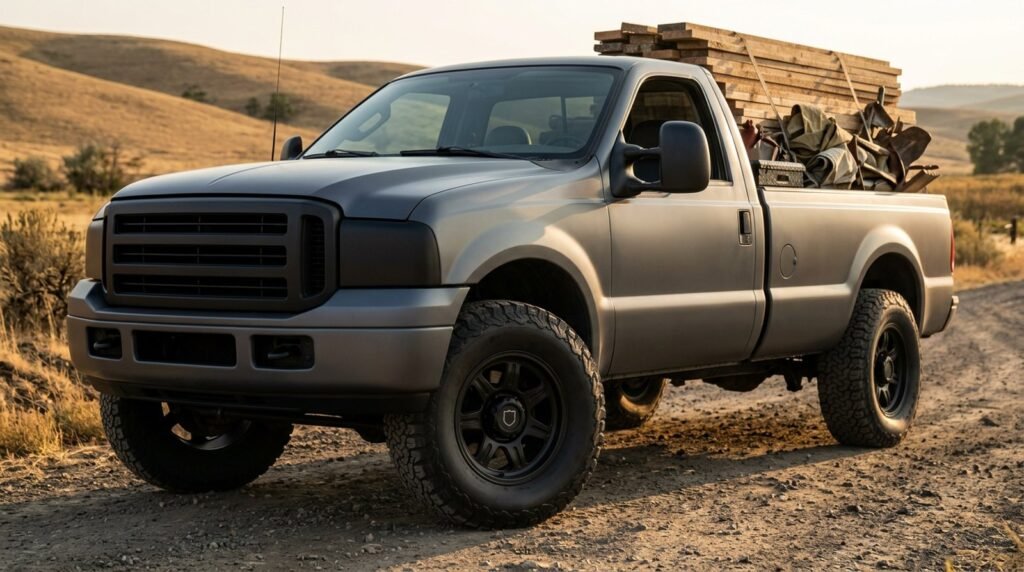
Every fitment guide on this site lists a "Wheel Load Rating" in kilograms per wheel — a number most buyers scroll past on the way to the offset and bolt pattern figures. It’s worth stopping on, because it’s the one spec on the page that’s actually a safety limit, not a styling preference.
What the Number Actually Means
A wheel’s load rating is the maximum static vertical load that single wheel is certified to carry, tested under a rotating bending load and a radial fatigue load on a certification rig. In the US, that testing follows SAE J2530; in Japan and much of the rest of the world, the equivalent standards are JWL and VIA. The number stamped or documented for a given wheel is the load it survived under that test protocol — not a load it merely tolerates for a moment, but one it holds up under repeated cyclic stress meant to simulate years of real driving.
Where the Minimum Comes From
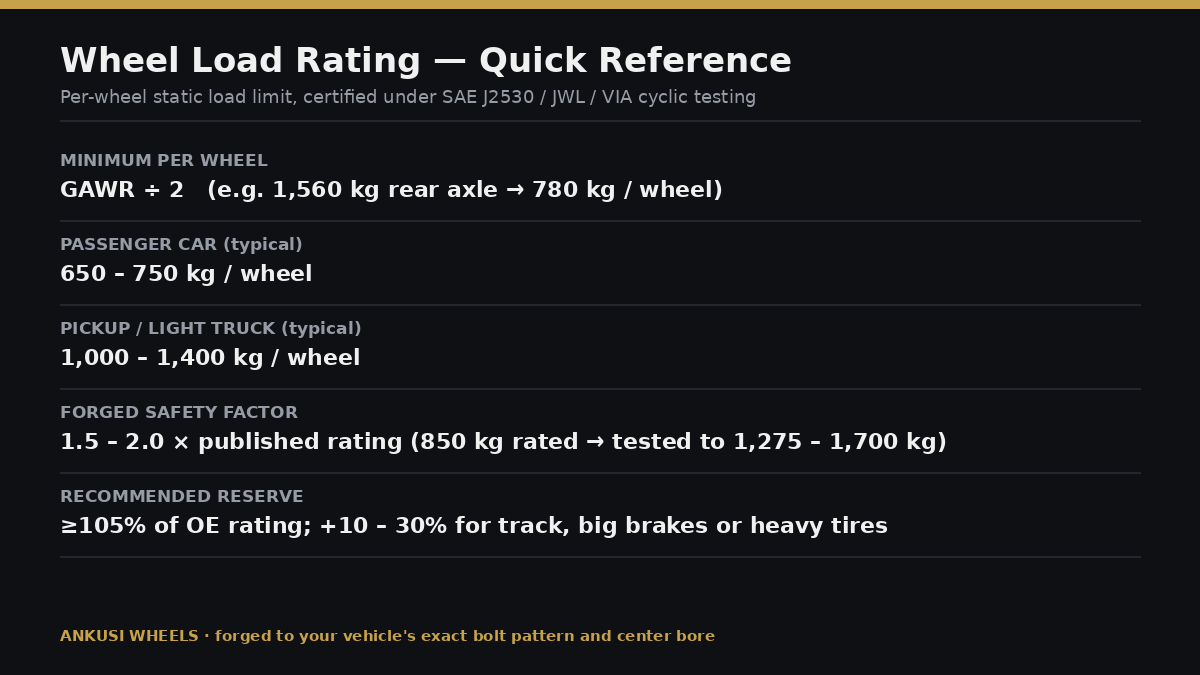
The starting point for any load rating is the vehicle’s Gross Axle Weight Rating (GAWR), split across two wheels on that axle. A rear axle rated for 1,560kg total needs each wheel to handle at least 780kg on its own. That’s the floor, not the target — it assumes perfectly even weight distribution and doesn’t yet account for cornering loads, potholes, or a full trunk. This is why ANKUSI’s fitment guides list load rating as a segment-level reference (for example, 650–750 kg/wheel for a standard passenger car, or 1,000–1,400 kg/wheel for a pickup or light truck) — it reflects real GAWR-derived ranges for that class of vehicle, not a single generic number applied to everything.
Why Quality Forged Wheels Build In Extra Margin
A well-built forged wheel typically has a safety factor of 1.5 to 2.0 built into its published rating — meaning a wheel rated for 850kg was actually tested to hold 1,275–1,700kg before any deformation. Some manufacturers’ fitment guidelines go further, recommending that a replacement wheel’s load rating equal or exceed 105% of the original factory wheel’s rating, specifically to preserve that safety buffer rather than build right up to the vehicle’s bare minimum requirement.
This margin isn’t theoretical on a heavier or more powerful build. Bigger brakes, wider and heavier tires, or a switch from a light economy trim to a performance variant of the same car all add real static and dynamic load to each wheel. Track use adds cornering loads that a straight-line load rating doesn’t capture at all — which is one reason a 10–30% reserve above the vehicle’s minimum requirement is a common recommendation for anyone doing more than daily commuting.
How This Plays Out on a Forged Wheel Order
Because forging aligns the wheel’s grain structure under pressure rather than casting it into shape, a forged wheel can hit the same or higher load rating as a factory wheel at meaningfully lower weight — the strength-to-weight advantage that makes forging worth the extra cost over casting in the first place. When ANKUSI builds to your vehicle’s confirmed bolt pattern and center bore, we size the wheel’s structure to meet or exceed the load figure your specific platform requires, not a generic number for the wheel diameter alone.
If you’re speccing wheels for a heavier tire package, a brake upgrade, or track use, mention it when you reach out — the right load rating for that build may be higher than what the stock configuration needed. Check your vehicle’s listed load rating on its page in our Wheel Fitment Guide, or contact ANKUSI directly with your build plans and we’ll confirm the right spec before anything is forged.
Need answers from the manufacturing side instead of just sales copy?
Contact ANKUSI through WhatsApp or WeChat for discussions on forged wheel customization, fitment, finishes, and project feasibility.