
How Forged Wheels Are Made: 9 Steps From Billet to Wheel
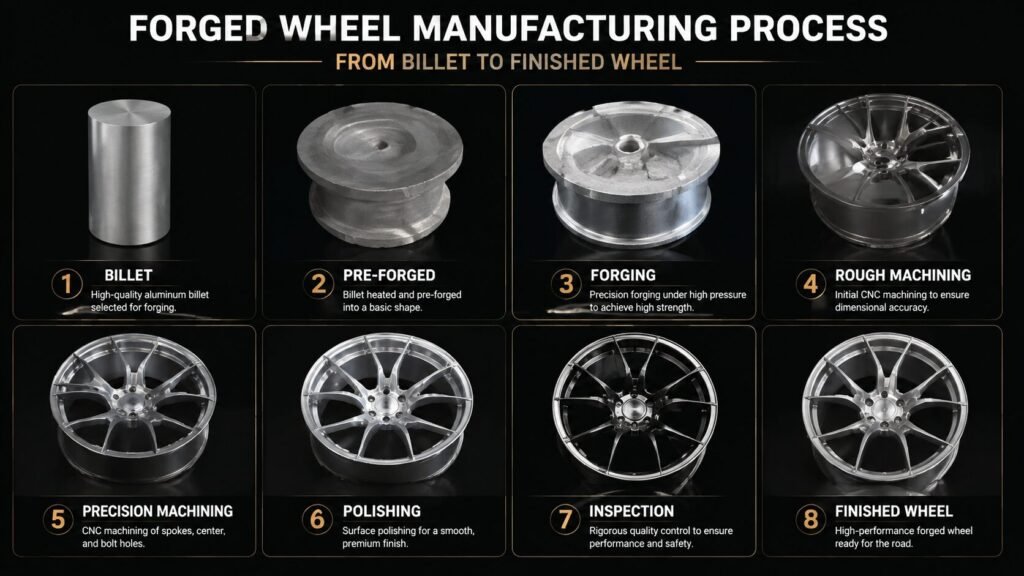
Forged wheels are made by heating a solid 6061-T6 aluminum billet, pressing it into a wheel-shaped blank under thousands of tons of force, heat treating it, and then machining every surface on CNC lathes and mills before finishing and inspection. The press step is what makes a wheel "forged": it squeezes the metal instead of pouring it, so there is no casting porosity and the grain follows the shape of the wheel. Below is how forged wheels are made at the ANKUSI factory in Guangzhou, step by step, with the numbers behind each stage and the questions worth asking any supplier.
How Forged Wheels Are Made: The Short Answer
A forged wheel goes through nine stages: billet cutting, heating and pre-forging, closed-die forging, heat treatment, rough turning, CNC programming, precision milling and drilling, finishing, and final inspection. Forging gives the strength; machining gives the exact size, offset and bolt pattern; finishing and inspection decide whether the wheel looks and performs the way it should.
- Cut a 6061-T6 billet to the weight calculated for the wheel size.
- Heat the billet and pre-forge it into a rough disc.
- Forge the blank in a closed die on a 10,000-ton press.
- Heat treat the blank back to T6 strength.
- Rough-turn the barrel and face on a CNC lathe.
- Program toolpaths for the exact design, offset and PCD.
- Mill the spokes and drill the bolt holes and centre bore.
- Polish, paint, brush or chrome the surface.
- Inspect dimensions, runout, finish and test standards.
How Forged Wheels Are Made: The Process at a Glance
The table below sums up each stage, the figures that control it, and what goes wrong when a factory cuts corners. Temperatures for 6061 come from published alloy data; the press size and lead time are our own production figures.
| Stage | What happens | Key numbers | If it is rushed |
|---|---|---|---|
| 1. Billet | 6061-T6 bar cut to weight | Weight set per wheel size | Underfilled die, weak spokes |
| 2. Heating and pre-forging | Billet heated, pressed into a rough disc | 6061 forging range 430–480 °C | Too cold: cracks; too hot: coarse grain |
| 3. Forging | Closed-die press forms the blank | 10,000-ton press | Small press: incomplete fill, uneven density |
| 4. Heat treatment | Solution treat, quench, artificially age | About 530 °C, then 160 °C for 18 h or about 175 °C for 8 h | Soft wheel, lower fatigue life |
| 5. Rough turning | Lathe sets barrel and face profile | Allowance left for finishing cuts | Runout carried into the finished wheel |
| 6. CNC programming | Toolpaths built from the order spec | Offset, PCD, centre bore per order | Wrong fitment, no fix after cutting |
| 7. Milling and drilling | Spokes, windows, lug seats, bore | Tolerances in fractions of a millimetre | Vibration, lug seats that do not seat |
| 8. Finishing | Polish, then paint, brush or chrome | Dust-free coating line | Tool marks or specks under the paint |
| 9. Inspection | Dimensions, runout, finish, test standard | SAE J2530 / JWL / VIA by market | Defects reach the customer |
Step 1–2: The 6061-T6 Billet and Pre-Forging
Every forged wheel starts as a solid bar of 6061 aluminum alloy, a magnesium-silicon alloy that forges well and reaches a typical tensile strength of about 310 MPa and yield strength of about 270 MPa in the T6 temper. The bar is cut to a weight calculated for the target diameter and width, because too little metal leaves the die underfilled and too much wastes material and press force.
The cut billet is then heated into the forging range. For 6061 that range is roughly 430–480 °C: below it the metal resists flow and can crack, above it the grain grows coarse. A first press stroke flattens the hot billet into a thick disc, which spreads the metal evenly before the main forging die.
Step 3: Closed-Die Forging on a 10,000-Ton Press
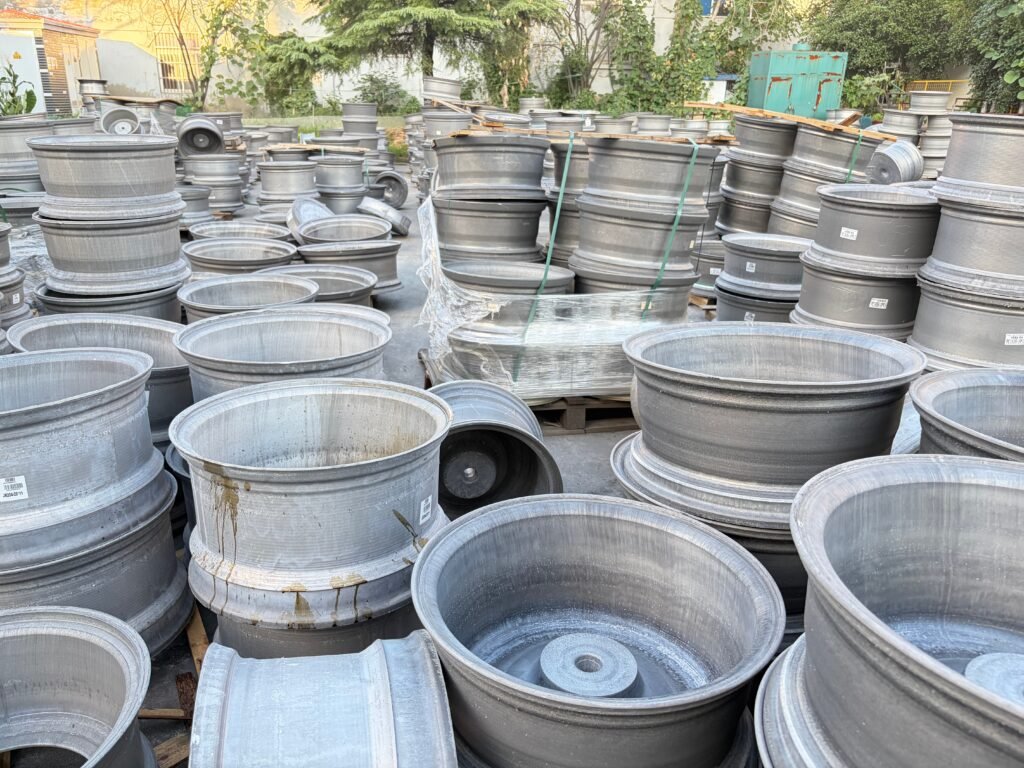
Forging is the step that defines how forged wheels are made: a closed die on a 10,000-ton press squeezes the hot disc into a wheel-shaped blank in which the metal fills the face and barrel without any pouring or mould. Because the metal is pressed rather than cast, there are no gas pockets or shrinkage voids, and the grain is stretched along the spokes and barrel instead of lying in random crystals.
This is why forged wheels can use thinner spokes for the same load rating. It is also why press size matters: a press that is too small for the wheel diameter leaves areas of lower density, usually at the outer spoke roots and the rim flange. Our forged vs cast wheels comparison explains the strength and weight difference in more detail.
Step 4: Heat Treatment Back to T6
Heat treatment restores full strength after forging, because the hot work softens the T6 condition the billet started with. In the standard 6061-T6 cycle, the part is solution treated at about 530 °C (985 °F), quenched in water, and then aged at 160 °C for about 18 hours or at about 175 °C for about 8 hours.
This is one of the least visible steps and one of the easiest to shortcut, so it is worth asking any supplier whether the forged blank is heat treated after forging and whether hardness is checked afterwards. A wheel that skips or shortens this step looks identical on the shelf but has lower fatigue life on the road.
Step 5–7: Turning, CNC Programming and Precision Milling
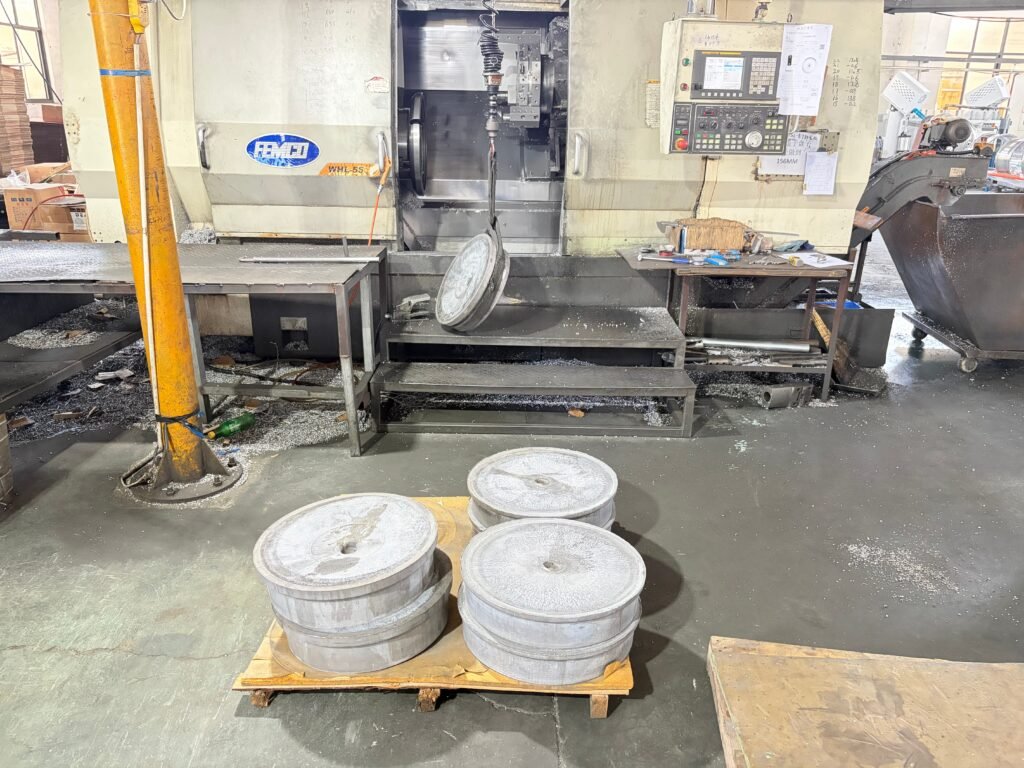
Machining is where forged wheels are made to fit one specific car. The blank first goes onto a CNC lathe that turns the barrel, rim flanges and face profile close to final size. Then the toolpaths are programmed from the order sheet: spoke design, width, offset, bolt pattern and centre bore. A custom offset or an unusual PCD costs programming time, not a new mould, which is why forged wheels can be made to order in small quantities.
Multi-axis CNC mills then cut the spoke shape, windows, lug seats and centre bore. The hub face and bolt holes must be exact, because nothing can be adjusted after the wheel is finished. Before you order, it helps to confirm the numbers your car needs: our wheel fitment guide lists bolt pattern, centre bore and factory offset by model and year, and the offset and backspacing calculator shows how a new offset moves the wheel.
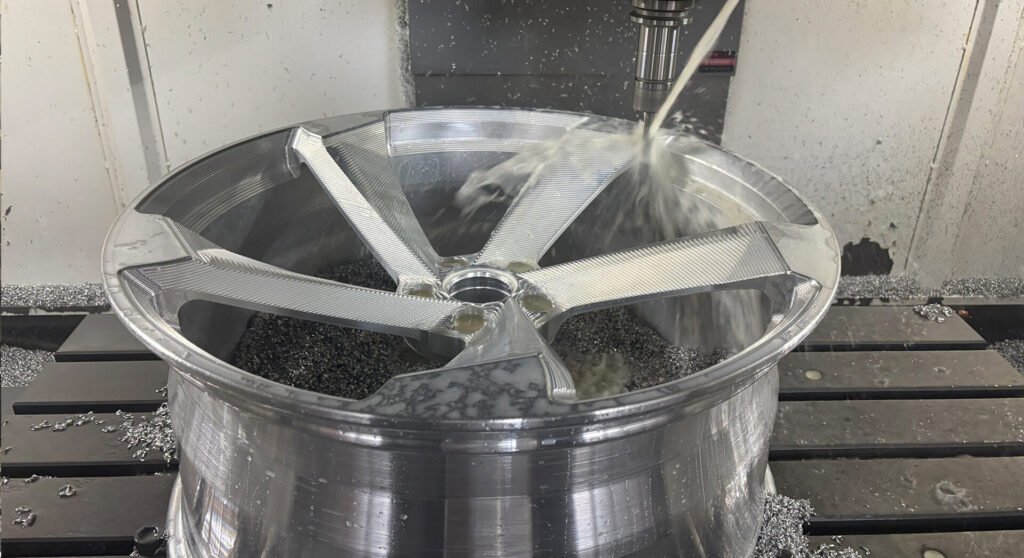
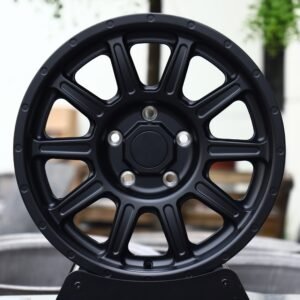
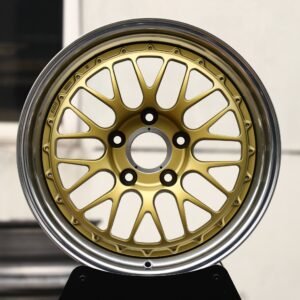
Most of the original forging ends up as chips. A monoblock design such as this matte black 10-spoke off-road monoblock is milled from one piece, while a two-piece wheel like this gold cross-spoke mesh 2-piece with polished lip pairs a forged centre with a separate barrel, which allows very deep lips and wide widths.
Have a car and a size in mind? Send us the model, year and the look you want, and we will reply with a drawing and a quote. Request a forged wheel quote.
Step 8: Polishing and Finishing
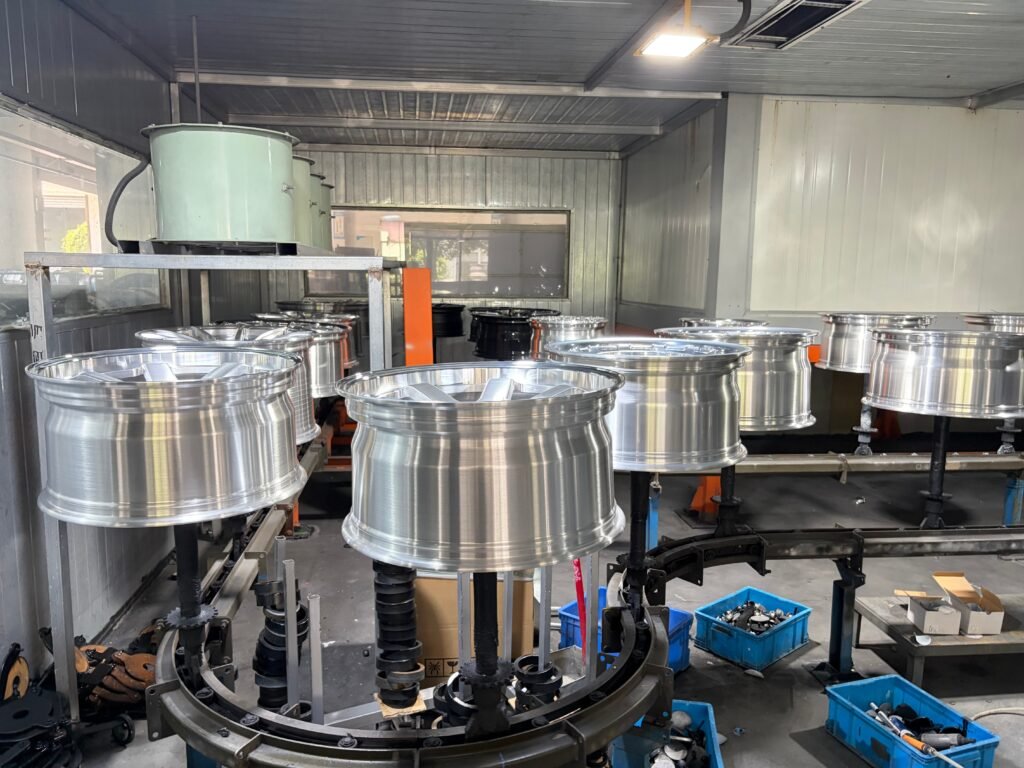
How forged wheels are made also decides how they look: finishing quality depends on preparation more than on paint. Before any colour goes on, the machined wheel is polished to remove tool marks; skipping this is how machining lines end up visible through a gloss coat. The wheel then receives its final surface: full paint, machined face with contrast colour, brushed, polished, or chrome, applied in a dust-free coating area because a single particle shows as a visible defect.
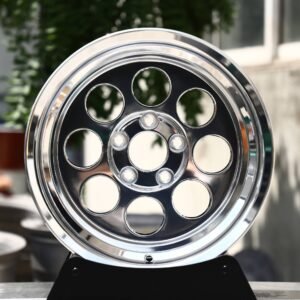
Highly polished finishes need the most hand work, as on this polished round-hole deep dish wheel, where any scratch left from machining would show in the mirror surface.
Step 9: Inspection and Test Standards
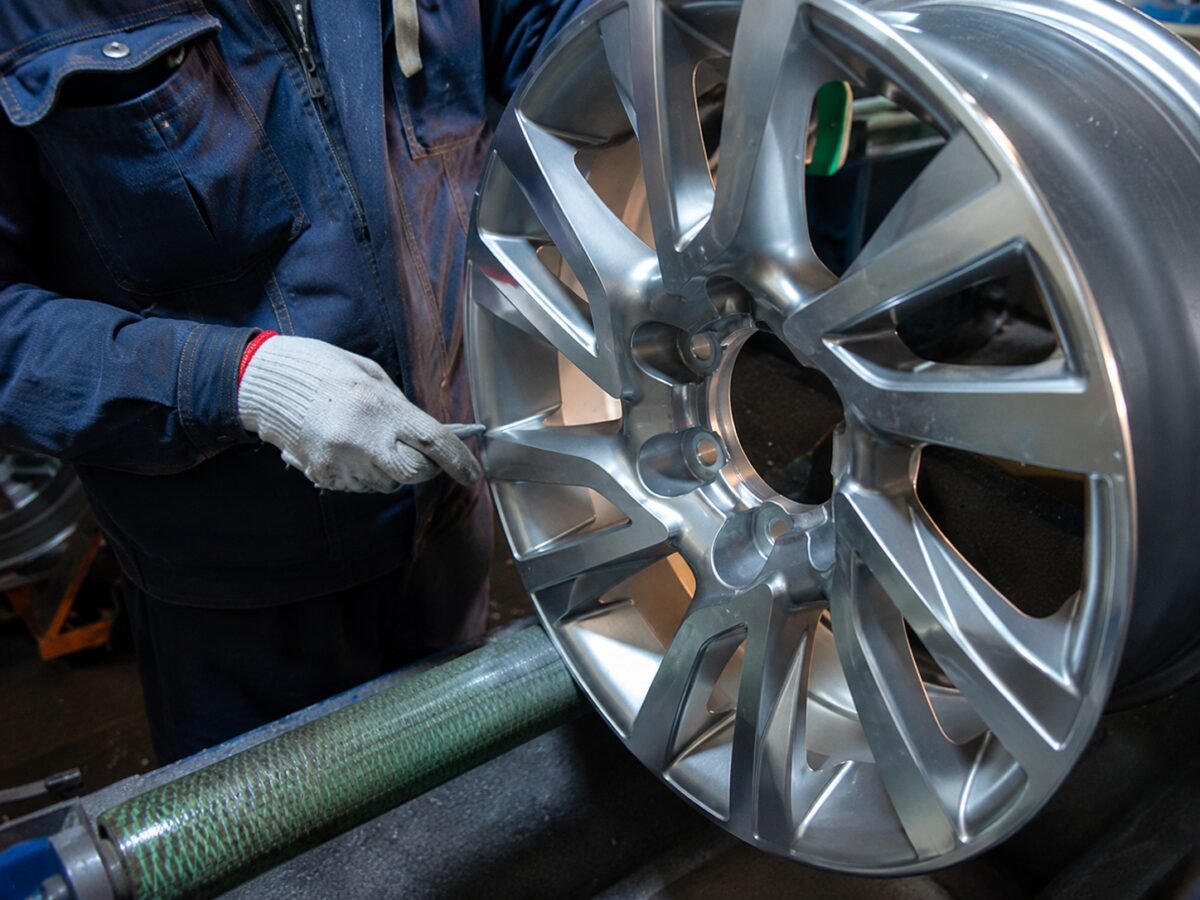
Inspection is the last stage of how forged wheels are made and the last chance to catch a problem before shipping. Each wheel is checked against its order sheet for diameter, width, offset, bolt pattern and centre bore, spun to check runout, and inspected visually for finish defects.
Wheel designs are validated against recognised test procedures. In the US aftermarket, SAE J2530 covers three areas: dynamic cornering fatigue (side loads while cornering), dynamic radial fatigue (vehicle weight on a mounted tyre) and impact (a simulated kerb or pothole strike). Japan uses JWL with VIA registration, and Germany uses TÜV approval. If a wheel ever has a quality problem caused by the wheel itself, our shipping and returns policy covers a free replacement wheel.
What to Ask a Forged Wheel Supplier
Knowing how forged wheels are made is most useful when you judge a supplier, because the important steps are the ones buyers cannot see. Five questions cover the parts of the process that matter most.
- What press size is used for this diameter, and is the blank forged in a closed die?
- Is the blank heat treated to T6 after forging, and is hardness checked?
- Will I get a drawing with offset, PCD and centre bore to approve before machining?
- Which test standard applies to my market, and for which load rating?
- How is a wheel with a quality problem handled after delivery?
Production at ANKUSI runs 20–25 business days after the drawing is approved, and wheel prices start from US$220 per wheel. More about the factory is on our wholesale and factory page, and the full catalogue is grouped by style in monoblock forged wheels and 2-piece forged wheels.
Frequently Asked Questions
How are forged wheels made?
A solid 6061-T6 aluminum billet is heated to about 430–480 °C, pressed into a wheel-shaped blank in a closed die, heat treated back to T6, and then machined on CNC lathes and mills to the exact size, offset and bolt pattern before finishing and inspection.
What aluminum are forged wheels made from?
Most forged wheels, including ours, are made from 6061 aluminum in the T6 temper, a magnesium-silicon alloy with a typical tensile strength of about 310 MPa that forges well and resists corrosion.
Why are forged wheels stronger than cast wheels?
Forging presses solid metal instead of pouring it, so there are no casting voids and the grain follows the shape of the spokes and barrel. That allows a lighter wheel for the same load rating.
How long does it take to make a set of custom forged wheels?
At ANKUSI, production takes 20–25 business days after you approve the drawing, plus shipping time.
Can forged wheels be made to a custom offset or bolt pattern?
Yes. The CNC toolpaths are programmed for each order, so offset, width, bolt pattern and centre bore are set by your specification rather than by a fixed mould.
Forged Wheels Made in This Process
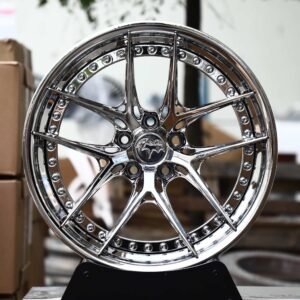
These designs from the current catalogue are made with the same process, in different constructions and finishes:
Browse all forged wheel collections
Frequently Asked Questions
How are forged wheels made?
A solid 6061-T6 aluminum billet is heated to about 430–480 °C, pressed into a wheel-shaped blank in a closed die, heat treated back to T6, and then machined on CNC lathes and mills to the exact size, offset and bolt pattern before finishing and inspection.
What aluminum are forged wheels made from?
Most forged wheels, including ours, are made from 6061 aluminum in the T6 temper, a magnesium-silicon alloy with a typical tensile strength of about 310 MPa that forges well and resists corrosion.
Why are forged wheels stronger than cast wheels?
Forging presses solid metal instead of pouring it, so there are no casting voids and the grain follows the shape of the spokes and barrel. That allows a lighter wheel for the same load rating.
How long does it take to make a set of custom forged wheels?
At ANKUSI, production takes 20–25 business days after you approve the drawing, plus shipping time.
Can forged wheels be made to a custom offset or bolt pattern?
Yes. The CNC toolpaths are programmed for each order, so offset, width, bolt pattern and centre bore are set by your specification rather than by a fixed mould.
Need answers from the manufacturing side instead of just sales copy?
Contact ANKUSI through WhatsApp or WeChat for discussions on forged wheel customization, fitment, finishes, and project feasibility.