
Forged vs. Cast Wheels: What Actually Makes Them Different
The Core Manufacturing Difference
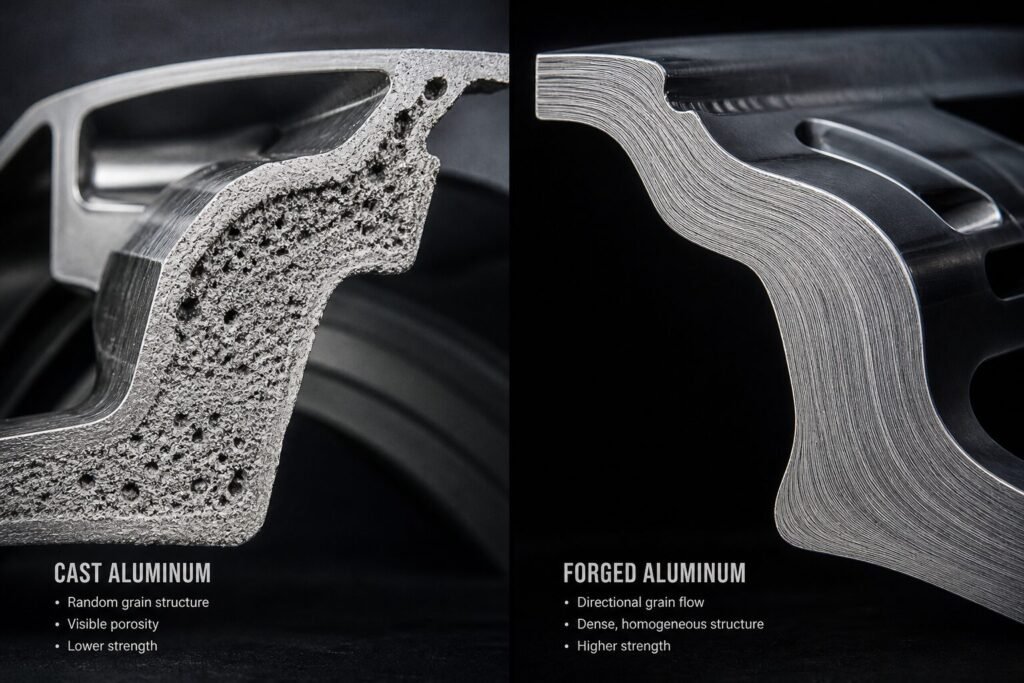
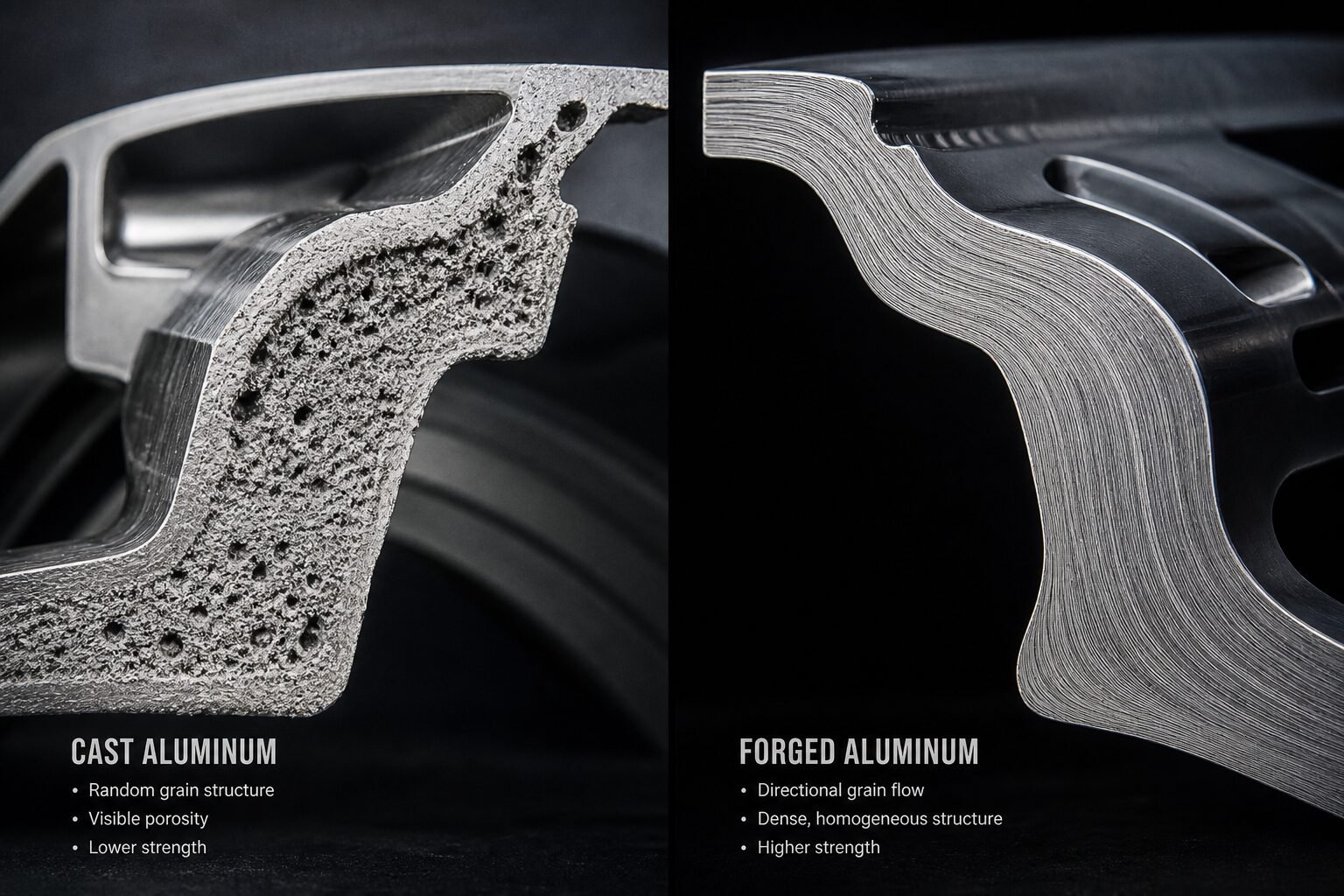
Cast wheels start as molten aluminum poured into a mold and left to cool. As the metal solidifies, its internal grain structure forms randomly, with microscopic gas pockets and porosity scattered through the material. Forged wheels start as a solid billet of 6061-T6 or 7075 aluminum alloy that's heated and then compressed under thousands of tons of pressure in a single press stroke. That compression doesn't just shape the metal — it physically realigns the internal grain structure along the contours of the wheel, closing porosity and producing a denser, more homogeneous part.
This is the single fact that explains almost every practical difference buyers notice between the two: strength, weight, cost, and how each type fails under stress.
Grain Flow: Why It's the Real Story
Metallurgists call this "grain flow," and it's the reason forging is used for parts that absolutely cannot fail — aircraft landing gear, crankshafts, connecting rods, and wheels for motorsport. In a cast part, the grain structure is essentially random, and any trapped gas pocket becomes a stress riser where a crack can start. In a forged part, the grain lines follow the shape of the component, the way growth rings in a tree follow the trunk. Load paths through the wheel — from the hub through the spokes to the rim — run parallel to that grain flow, which is exactly where you want the material to be strongest.
Strength-to-Weight: What the Numbers Actually Show
In practical terms, a forged wheel is typically 15-25% lighter than a cast wheel of the same size and load rating, because the material itself is stronger, so less of it is needed to hit the same strength target. That weight comes off almost entirely as unsprung and rotating mass — the single most valuable place to cut weight on a car, since it improves acceleration, braking, and steering response more than an equivalent reduction in body weight. Tensile strength for forged 6061-T6 aluminum typically runs 20-30% higher than the same alloy cast, and elongation (a measure of how much the material can deform before fracturing rather than snapping) is usually two to three times better.
Where Cast Wheels Still Make Sense
None of this makes cast wheels a bad product. For a daily-driven car under normal road conditions, a well-designed cast wheel from a reputable manufacturer is safe, durable, and considerably cheaper to produce, which is why the overwhelming majority of OEM wheels on the road are cast or, increasingly, flow-formed. Casting also allows more intricate multi-spoke designs at lower tooling cost, since the mold can be shaped freely, whereas forging pushes material outward from a simpler starting shape and has more geometric limits. If you're not tracking the car, hauling heavy loads off-road, or chasing every gram of rotating weight, the case for paying a forged premium is weaker.
Flow-Formed: The Middle Ground
Flow forming (also called rotary forging) starts with a cast blank and then spins it under heat while rollers compress and stretch the barrel outward. It doesn't fully forge the face of the wheel, but it does align grain structure in the barrel, closing the gap between cast and forged for a fraction of the cost of full forging. It's a reasonable middle-ground choice if budget is the constraint but you still want a real strength benefit over a straight casting.
Forged vs. Cast vs. Flow-Formed: Side-by-Side
| Attribute | Cast | Flow-Formed | Forged |
|---|---|---|---|
| Process | Poured into mold | Cast blank, then spin-formed barrel | Billet compressed under press |
| Typical weight vs. cast | Baseline | 5-10% lighter | 15-25% lighter |
| Relative tensile strength | Baseline | Moderate increase | 20-30%+ higher |
| Impact/fatigue resistance | Lower | Improved in barrel only | Highest, full wheel |
| Cost | $ | $$ | $$$ |
| Best for | Daily driving, budget builds | Street/light performance | Track, off-road, heavy load, show builds |
How to Tell If a Wheel Is Actually Forged
"Forged" gets used loosely in marketing, so it's worth knowing what to check. A genuine forged wheel will carry a JWL/VIA or equivalent certification mark and a manufacturer spec sheet listing the forging process and alloy grade — ask for it. Weight is a reasonable proxy: for a given size and load rating, a forged wheel should weigh noticeably less than a cast equivalent from the same brand's catalog. If a shop can't tell you the alloy or the press tonnage used, treat the "forged" claim with skepticism.
For the full production sequence, from billet and forging press to heat treatment, CNC machining and inspection, see how forged wheels are made, step by step.
FAQ
Is a forged wheel actually worth the extra cost for a street car?
If you value unsprung weight reduction, ride quality, and long-term durability against curb strikes and potholes, yes. If the car is a daily commuter and budget is the priority, a quality cast or flow-formed wheel is a reasonable choice.
Can a cracked forged wheel be repaired?
Cracks in the structural areas of any wheel — cast or forged — should not be welded and returned to service; the heat from welding disrupts the grain structure in ways that are difficult to verify without lab-grade inspection. Cosmetic curb rash and non-structural repairs are a different matter.
Do forged wheels bend less on potholes and curb strikes?
They're more resistant to bending and cracking than cast wheels of the same weight because of the denser, more uniform grain structure, but no aluminum wheel is unbreakable — hit something hard enough and any wheel can fail.
Custom sizing, PCD or offset not covered here? Contact ANKUSI and we'll confirm the correct forged wheel spec for your build.
Need answers from the manufacturing side instead of just sales copy?
Contact ANKUSI through WhatsApp or WeChat for discussions on forged wheel customization, fitment, finishes, and project feasibility.